
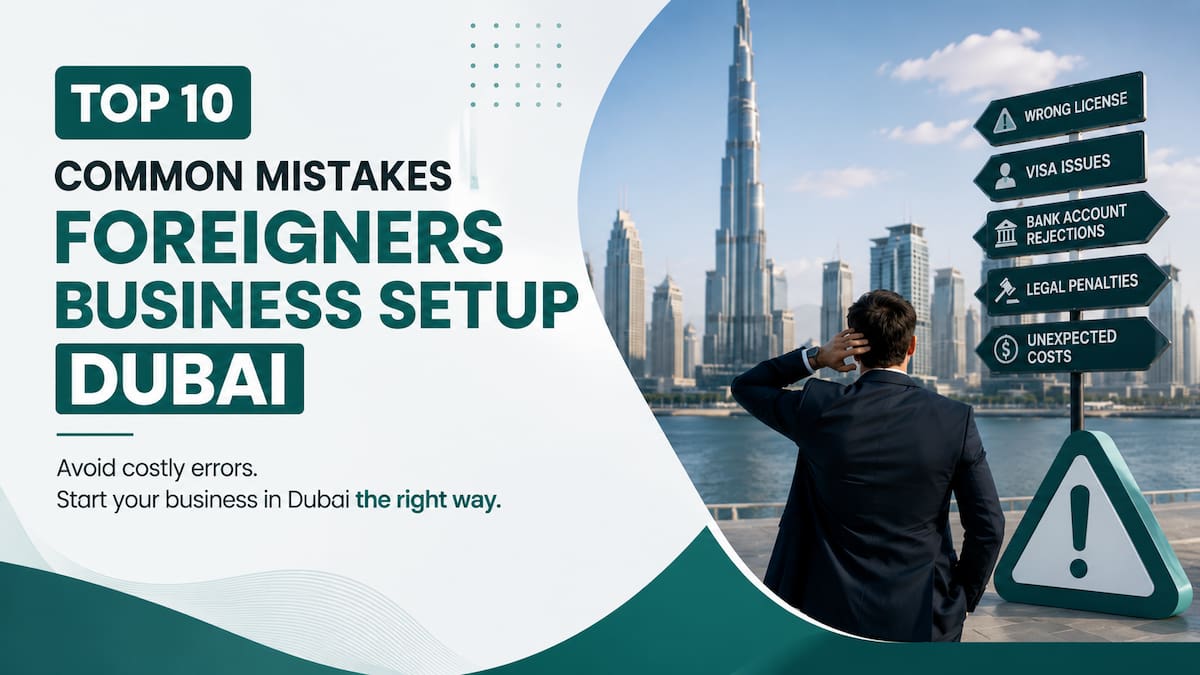
Dubai is one of the world’s most investor-friendly cities – zero personal income tax, world-class infrastructure, a booming economy, and a gateway to markets across the Middle East, Africa, and South Asia. It’s easy to see why thousands of entrepreneurs from around the globe choose Dubai as their business home every year.
But setting up a business here isn’t as simple as picking a trade name and signing a lease. The UAE has its own regulatory framework, legal nuances, and cultural dynamics that catch many first-time foreign investors off guard. The result? Costly delays, legal complications, or businesses that never quite get off the ground.
If you’re a foreigner planning to start a business in Dubai, this guide is for you. We’ve put together the most common and most avoidable mistakes that hold entrepreneurs back, so you can move forward with clarity and confidence.
Common Mistakes Foreigners Make When Setting Up a Business in Dubai
Here are the biggest mistakes foreign entrepreneurs often make while starting a business in Dubai.
1. Choosing the Wrong Business Jurisdiction
This is where a large number of foreign entrepreneurs go wrong from the very start. Dubai offers three main business jurisdictions: Mainland, Free Zone, and Offshore, and they are not interchangeable.
- Mainland companies can trade directly anywhere in the UAE and take on government contracts, but involve more regulatory requirements.
- Free Zones offer 100% foreign ownership, tax benefits, and simplified setup, but some have restrictions on trading directly with the UAE mainland market.
- Offshore structures are designed primarily for holding assets, international trading, or tax planning, they cannot conduct business inside the UAE.
Many foreigners pick a free zone because it sounds appealing, only to discover later that their business model requires mainland access. Others set up on the mainland without understanding the added compliance and cost involved. The right choice entirely depends on your industry, target market, and growth plans. Get this decision wrong and you’ll either be limited in what you can do or end up restructuring at significant expense.
2. Not Researching the Right Business Activity
In the UAE, every business must be registered under a specific licensed activity, and you can only legally conduct the activities listed on your licence. This is more granular than most countries. Activities are categorised under commercial, professional, industrial, and tourism licences, and within each category, there are hundreds of sub-activities.
A common mistake is registering under a broad or inaccurate activity because it seemed close enough. For example, registering as a “management consultancy” when your actual work involves financial advisory, which requires a different licence and regulatory approval entirely.
Before you apply for your licence, map out every service or product your business will offer and make sure each one is reflected accurately in your activity list. Adding activities later is possible but adds time and cost.
3. Skipping Due Diligence on the Local Sponsor or Service Agent
Prior to the UAE’s 2021 Commercial Companies Law reforms, most mainland businesses required a UAE national to hold 51% ownership as a local sponsor. While full foreign ownership is now permitted across a broad range of activities, certain sectors, including oil and gas, defence, and some regulated industries, still require Emirati partners or service agents.
Many foreigners who set up before fully understanding this either:
- Entered into poorly drafted sponsorship agreements with no exit clauses
- Paid fees without a proper legal contract in place
- Chose a sponsor without verifying their reputation or legal standing
Even where a local service agent is required (rather than a full partner), treat the arrangement with the same legal seriousness you would any business partnership. Have a qualified UAE lawyer draft or review the agreement.
4. Underestimating the Total Cost of Setup
Dubai is often marketed as a low-cost setup destination, and compared to many Western markets, it genuinely is. But one of the most common errors during UAE business setup is budgeting only for the licence fee and nothing else.
The real cost of setting up includes:
- Trade name reservation
- Initial approval fees
- Memorandum of Association (MoA) drafting and notarisation
- Office space or flexi-desk lease (required for most licences)
- Visa allocation and immigration card fees
- Medical testing and Emirates ID for each visa
- Bank account opening fees
Depending on the free zone or mainland authority, and the number of visas you need, the total setup cost can be significantly higher than the headline licence fee suggests. Always ask for a comprehensive cost breakdown upfront and budget for renewal, which typically comes around every one to three years.
5. Rushing the Trade Name Selection
Trade names in Dubai must comply with UAE naming conventions. They cannot include offensive language, references to religion or ruling families, or names that imply a government connection. If your business name includes your personal name, it must be your full legal name, not a shortened version or nickname.
Many foreigners come to Dubai with a brand name they’ve already built elsewhere, only to find it’s taken, prohibited, or doesn’t meet the naming guidelines. The fix might seem minor, such as adding a word, changing a letter, but it can affect your brand identity, domain, and marketing materials significantly.
Check name availability and compliance early. Don’t wait until you’re deep into the registration process.
6. Not Having a Proper Office Arrangement
The UAE requires businesses to have a registered physical address, and in most cases, proof of a tenancy contract (Ejari for mainland, or a lease agreement within a free zone). A P.O. Box or a friend’s address will not suffice.
Some entrepreneurs try to cut costs by using an unregistered address or skipping workspace entirely. Beyond being non-compliant, this creates problems when it comes to opening a bank account, processing visas, or renewing your licence.
If your business doesn’t need a full office, many free zones and business centres offer flexi-desk or virtual office packages that meet the regulatory requirements at a fraction of the cost of a dedicated space. Just make sure the arrangement is officially registered and documented.
7. Leaving the Bank Account for Last
Opening a corporate bank account in the UAE is not a formality. UAE banks have rigorous compliance and due diligence requirements, particularly for foreign-owned businesses. Anti-money laundering (AML) regulations mean that banks carefully scrutinise business models, source of funds, and the background of shareholders.
The most common mistakes here:
- Assuming any bank will approve you quickly
- Applying to a single bank without a backup plan
- Not having a clear, documented business plan ready
- Having a complex ownership structure with multiple offshore holding layers
Account opening can take anywhere from two weeks to several months. Some businesses get rejected multiple times before finding the right banking partner. Start the bank account process as early as possible, prepare your documentation thoroughly, and consider working with a consultant who has banking relationships in the UAE.
8. Ignoring VAT and Tax Obligations
The UAE introduced 5% VAT in 2018, and more recently, a 9% Corporate Tax came into effect for financial years starting on or after 1 June 2023. This represents a significant shift from the tax-free reputation on which Dubai built its brand.
A surprisingly common mistake among foreigners, especially those who set up a few years ago or are setting up now based on outdated advice, is assuming the UAE remains entirely tax-free.
If your business earns above the VAT registration threshold (currently AED 375,000 in annual taxable turnover), VAT registration is mandatory. Corporate tax applies to most businesses earning above AED 375,000 in net profit, with free zone businesses potentially eligible for a 0% rate under certain conditions.
Non-compliance isn’t just a financial risk; it can affect your licence renewal and reputation with UAE authorities. Get proper accounting and tax advice from the start, not as an afterthought.
9. Mismanaging the Visa Process
A UAE business licence entitles you to a certain number of employment visas depending on your licence type and office space. But many new business owners misunderstand how this works.
Common visa-related mistakes include:
- Assuming the business licence automatically gives you residency (it doesn’t — you must apply for an investor or partner visa separately)
- Over-hiring before understanding your visa quota
- Not understanding the requirements for bringing dependants (spouse, children) on a residency visa
- Missing the 60-day window to convert a visit visa to a residence visa
Visa processing has specific timelines, medical requirements, and documentation. Mistakes here can result in overstay fines, deportation orders for employees, or delays in getting your team on the ground.
10. Trying to Do Everything Without Professional Help
The biggest mistake of all and the one that often leads to all the others is attempting to navigate Dubai’s business setup process alone, based on online research or advice from well-meaning friends who “did it a few years ago.”
The regulatory environment in the UAE evolves regularly. Rules around foreign ownership, free zone regulations, tax obligations, and approved activities are updated, and what was accurate two years ago may not apply today. The mistakes foreigners make when setting up a business in Dubai are almost always avoidable with the right guidance.
Working with a reputable business setup consultancy doesn’t just save you time it protects you from making decisions that are expensive to reverse.
Set Up Right the First Time
Dubai is genuinely one of the best places in the world to build a business. But getting here takes more than enthusiasm; it takes the right structure, the right licences, the right accounts, and the right advisors.
At AE Setup, we’ve helped thousands of foreign entrepreneurs set up successfully in Dubai and across the UAE. From choosing the right jurisdiction and activity to managing visas, bank accounts, and compliance, we handle the complexity so you can focus on building your business.
Ready to get started? Contact AE Setup today for a free consultation.