
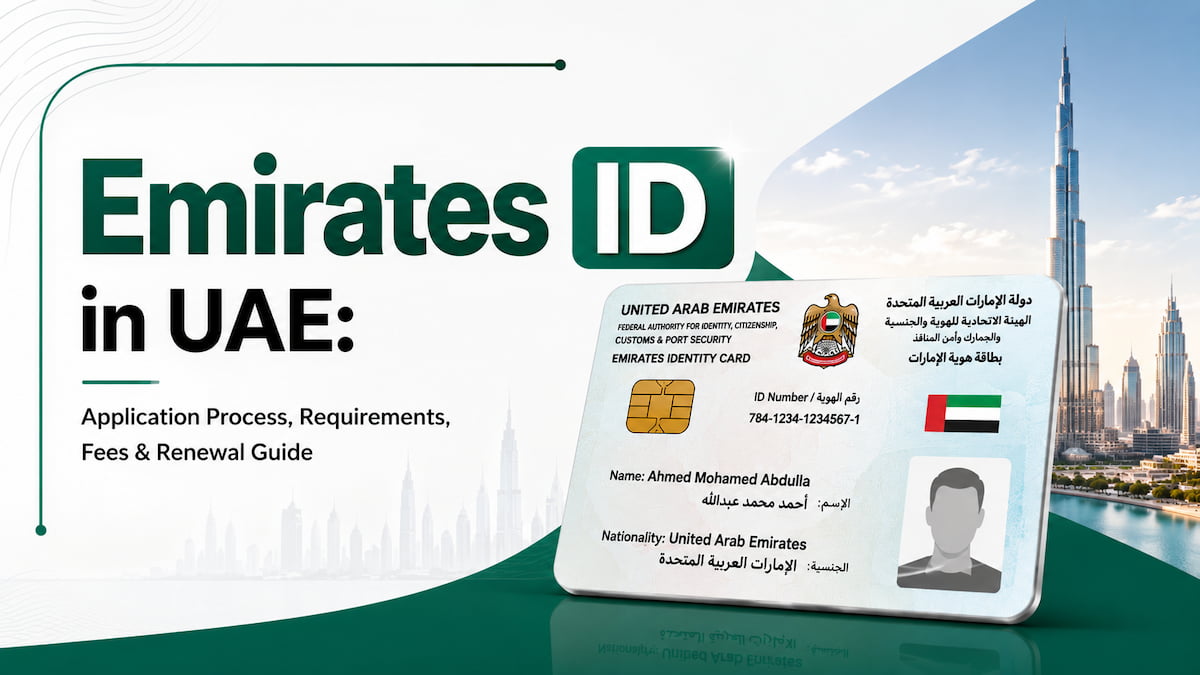
Here’s the short answer: the Emirates ID is the mandatory national identity card issued to every citizen and resident of the UAE by the Federal Authority for Identity, Citizenship, Customs and Port Security (ICP). It carries your unique Emirates ID number, your photo, fingerprints, and your residency or citizenship status on an embedded smart chip, and you’ll need it for almost everything – from opening a bank account to picking up a parcel.
This guide walks through what the Emirates ID is, who needs one, how the application and renewal process works in 2026, current fees and validity periods, and the small details that cause the biggest delays at typing centres.
What Is the Emirates ID in the UAE?
The Emirates ID, officially the Emirates Identity Card, is issued under the authority of the ICP, the federal body responsible for identity, citizenship, customs and immigration across the UAE. Holding a valid card is a legal requirement for UAE nationals, GCC nationals resident in the UAE, and every expatriate resident, regardless of age.
Physically, the card is made from polycarbonate, the same durable material used in biometric passports, and is roughly the size of a standard credit card. It carries an embedded smart chip that stores your personal details, biometric data (fingerprint and facial image), and your current residency or visa status, making it a single, tamper-resistant identity document.
Since the visa-sticker system was phased out for most categories, your Emirates ID and your residency record have effectively merged. Immigration officers, banks, hospitals and government portals all verify your status directly from the card’s chip or the linked ICP database, so keeping the card valid and your details up to date matters more than ever.
Who Needs an Emirates ID in the UAE?
There’s no minimum age and no exemption. If you live in the UAE, you need a card. That includes:
- UAE nationals – issued with longer validity periods of 5 or 10 years
- Expatriate residents on any visa category – employment visa, investor visa, partner visa/family visa, Golden Visa, freelance, retirement, or remote-work visas
- GCC nationals resident in the UAE
- Children and dependents – every sponsored family member, including newborns, needs their own card
Why the Emirates ID Matters: Everyday Uses
The Emirates ID isn’t just an identity document; it’s the access key to most services in the country. You’ll be asked for it, or its number, for:
- Banking: Opening accounts, applying for credit cards, loans or mortgages
- Healthcare: Registering with insurers, hospital visits, pharmacy purchases
- Telecom and utilities: SIM card registration, DEWA and other utility connections
- Housing: Ejari tenancy contract registration
- Employment: Labour contract registration and work permit verification
- Education: School and university enrolment for dependents
- Travel: Smart gate access at UAE airports for faster immigration
- Digital government services: Your sign-in credential for UAE Pass and thousands of linked e-services
How to Apply for an Emirates ID in the UAE (Step-by-Step)
For new residents, the Emirates ID application is now bundled into the entry permit and residence visa process rather than handled as a separate errand. Here’s how it works.
Documents You’ll Need
- Valid passport (original and copy)
- Entry permit or residence visa
- Passport-size photo meeting ICP specifications (white background; no glasses, headwear or smiling, except for religious headwear)
- Completed application, submitted digitally via a typing centre or ICP Smart Services
- For renewals: your existing Emirates ID
- For newborns: birth certificate plus a parent’s Emirates ID
The Application Process
- Complete the mandatory medical fitness test (for new residents) before visa stamping and Emirates ID issuance.
- Submit your application through ICP Smart Services (icp.gov.ae or the ICP app) or an ICP-accredited typing centre.
- Pay the applicable government and service fees.
- Attend biometric capture (fingerprints and a photo) at an ICP service centre. This step is usually skipped for renewals where biometrics are already on file, and for children under 15.
- Track your application status through the ICP app or UAE Pass.
- Receive your card by Emirates Post, or collect it from a service centre, once approved.
Standard processing takes around 7–10 working days. An urgent (Fawri) service is also available, mainly for lost or damaged card replacements, and can be processed within 24 hours for an additional fee.
Emirates ID Fees and Validity in 2026
Emirates ID costs are based on the card’s validity period rather than a flat rate. As of 2026, the government card fee is AED 100 per year of validity, plus a typing centre service charge. Here’s how that breaks down by applicant type:
| Applicant Type | Card Validity | Government Fee | Typical Service / Typing Fee |
| Expatriate resident (standard visa) | 1–3 years (matches visa) | AED 100 per year (e.g. AED 200 for 2 yrs, AED 300 for 3 yrs) | AED 30–50 |
| Golden Visa holders | Up to 10 years | Up to AED 1,000 | AED 30–50 |
| UAE nationals | 5 or 10 years | AED 500 / AED 1,000 | Minimal – covered under the Zero Bureaucracy initiative |
| GCC nationals | 5 years | AED 500 | AED 30–50 |
| Replacement / duplicate card | Remaining validity of original card | AED 300 | AED 30–50 |
| Urgent (Fawri) processing | — | + approx. AED 150 | — |
Late renewal carries a fine of AED 20 per day, capped at AED 1,000, once the grace period lapses. Fees and validity rules are set by the ICP and can be revised – always confirm current rates on icp.gov.ae or via the UAE Pass app before paying.
How to Renew Your Emirates ID
Renewal is tied to your residency visa for expatriates – when your visa is renewed, your Emirates ID needs to be renewed alongside it. UAE nationals can renew based on the card’s own expiry date, up to six months in advance.
Most renewals are now handled entirely online through ICP Smart Services or the UAE Pass app: confirm your details, pay the fee, and submit. Biometrics are only requested again if the system flags your existing data as outdated or incomplete – for most repeat renewals, you won’t need to visit a centre at all.
There’s a 30-day grace period after expiry, but don’t treat it as a deadline to aim for; an expired Emirates ID can disrupt banking, healthcare and other services even within that window, and fines of AED 20 per day (up to AED 1,000) apply once it lapses. For UAE nationals, renewal and replacement have been combined into a single step under the government’s Zero Bureaucracy initiative.
Lost, Stolen, or Damaged Emirates ID — What to Do
Report a lost, stolen, or damaged card immediately through the ICP app, UAE Pass, or the ICP website. Reporting quickly protects you from misuse of your ID number and starts the replacement process.
A duplicate card costs AED 300 plus the typing centre service fee. The replacement carries the remaining validity of your original card (it doesn’t restart the clock), and your 15-digit Emirates ID number stays the same; only the physical card’s serial number changes. Biometrics are generally not required again unless your existing data needs updating.
While you wait for the new card (usually around a week), keep a note of your Emirates ID number and access the digital copy via UAE Pass. Many services will accept the digital version in the meantime.
Emirates ID for Children and Dependents
Every dependent on your residency visa, including infants, needs their own Emirates ID. For newborns, you’ll need the birth certificate alongside a parent’s Emirates ID to apply.
Parents apply on behalf of children under 15, and no biometric appointment is needed at this stage. Once a child turns 15, fingerprints and a photo become part of the process, just like for adults.
Card validity and fees for dependents follow the same per-year structure as adult expatriate cards, scaled to the validity of the dependent’s own residency visa.
Emirates ID and UAE Pass: Your Digital Identity
UAE Pass is the country’s national digital identity platform, and it’s built directly on your Emirates ID. Once you register, by verifying your Emirates ID and completing a biometric check in the app, you get a digital version of your ID that’s accepted across thousands of government and private-sector services.
Beyond acting as a digital ID card, UAE Pass lets you sign documents electronically, renew your Emirates ID and visa without separate logins, and use a single sign-on across banking, telecom, healthcare and municipal platforms. If you’ve sorted your physical Emirates ID but haven’t registered for UAE Pass yet, it’s worth doing; it removes a lot of friction from everyday government interactions.
Common Mistakes That Delay Emirates ID Applications
Most Emirates ID delays come down to a handful of avoidable issues:
- Non-compliant photos: Wrong background, glasses, or expression leads to on-the-spot rejection
- Applying too early: Before medical test results or entry permit status are fully finalised in the system
- Letting the grace period run out: Waiting until the last day to renew
- Outdated personal details: Not updating your phone number, address, or marital status after life changes, which causes mismatches across linked services
- Sharing your card: An Emirates ID is tied to your identity, and lending it can create legal complications for both parties
Need Help With Emirates ID Processing in the UAE?
If you’re setting up a business, relocating, or sponsoring employees and family members in the UAE, Emirates ID processing is just one part of a much larger visa and immigration workflow, and a small detail can hold up everyone’s paperwork. At AE Setup, we handle Emirates ID applications, renewals and replacements as part of complete business setup and UAE residence visa packages, working alongside GDRFA Dubai and ICP Smart Services on your behalf. Speak to our team to get your Emirates ID sorted alongside your company formation or visa application – no separate appointments, no guesswork.
Frequently Asked Questions
1. What is Emirates ID in the UAE?
The Emirates ID is the official national identity card issued by the ICP to every UAE citizen and resident. It stores your identity details, biometric data, and residency status on a smart chip and is required for almost all government and private services in the country.
2. How much does an Emirates ID cost in 2026?
The government fee is AED 100 per year of validity – for example, AED 200 for a 2-year card or AED 300 for a 3-year card plus a typing centre service fee of around AED 30–50. UAE nationals pay AED 500 for 5 years or AED 1,000 for 10 years.
3. How long does it take to get an Emirates ID?
Standard applications are processed within 7–10 working days after biometrics are completed. An urgent (Fawri) replacement service can be processed within 24 hours for an additional fee.
4. Can I use my Emirates ID for travel outside the UAE?
No. The Emirates ID is for domestic identification, and your passport remains your travel document for international trips, although GCC nationals can sometimes use it for travel within the GCC.
5. What happens if my Emirates ID expires?
An expired Emirates ID can disrupt access to banking, healthcare and other essential services. After the 30-day grace period, late renewal attracts a fine of AED 20 per day, capped at AED 1,000.
6. Do children need their own UAE Emirates ID?
Yes. Every dependent, including newborns, needs an individual Emirates ID linked to their residency visa. Children under 15 don’t need to provide biometrics; this is required from age 15 onward.
7. Is the digital Emirates ID on UAE Pass valid for official use?
Yes. The digital Emirates ID accessible through the UAE Pass app is widely accepted across government and private-sector services and can be used alongside, or sometimes instead of, the physical card.